
You’re never too stiff for Pilates—it’s actually designed for bodies just like yours! Many beginners can’t touch their toes when they start, but instructors provide modifications for every exercise using props like bands and blocks. With consistent practice 2-3 times weekly, you’ll notice improvements within 6-8 weeks as Pilates simultaneously strengthens and lengthens tight muscles. The progression from stiff to flexible begins with your very first controlled movement.
The Myth of Needing Flexibility Before Starting Pilates
Contrary to what many believe, you don’t need to be flexible to start Pilates—in fact, that’s precisely why many people begin in the first place!
If you struggle to touch your toes or sit comfortably cross-legged, you’re actually the perfect candidate for a beginner’s class.
Pilates studios welcome tight bodies every day. Instructors are trained to accommodate various flexibility levels and will offer modifications suited to your current abilities.
Every body is a Pilates body—your tightness isn’t a barrier, it’s your starting point.
Most practitioners start with limited range of motion and improve gradually over time. Modifications are available for every exercise to accommodate physical limitations, allowing anyone to participate regardless of their current flexibility level. Simple pre-Pilates stretching techniques that focus on mobilizing hips can provide an excellent foundation for beginners feeling too stiff to start.
The low-impact nature of Pilates makes it ideal for those concerned about injury while working to improve their flexibility.
Why Pilates Actually Works Better for Inflexible Bodies
If you’re stiff as a board, you’re actually the perfect candidate for Pilates.
Your inflexible body will benefit from Pilates’ progressive approach that builds flexibility while simultaneously strengthening muscles, creating balanced development rather than just loose joints.
The beauty of Pilates is that every single exercise can be modified to work with your current abilities, making it an ideal practice for even the most inflexible beginners.
Research shows that Reformer Pilates can significantly improve body composition and muscular strength in overweight individuals when practiced consistently three times per week.
Builds Progressive Flexibility
While many believe flexibility is a prerequisite for Pilates, the truth reveals quite the opposite. Your “stiff” body is actually the perfect candidate for Pilates’ transformative effects.
Research consistently shows that Pilates builds flexibility progressively, even without specific stretching exercises. The controlled movements strengthen your core first, creating the stability your body needs to safely increase range of motion. Pilates emphasizes quality of movement rather than simply repeating exercises without proper form.
You’ll notice improvements within just 6 weeks, as your hamstrings and back become more flexible naturally through proper core engagement. Studies have demonstrated that Pilates is particularly effective for older women compared to traditional static stretching methods.
What’s remarkable is how this works for everyone—whether you’re middle-aged or in your 60s. As pain decreases during movement, your flexibility increases.
The beauty of Pilates is that it meets you exactly where you are, allowing your inflexible body to develop mobility at its own perfect pace.
Strengthens While Lengthening
Paradoxically, your stiff, inflexible body creates the perfect foundation for Pilates to work its magic.
Unlike high-intensity workouts that might strain tight muscles, Pilates simultaneously strengthens and lengthens, addressing the root cause of your stiffness. Your body isn’t fighting against itself—it’s transforming through balanced movement.
Here’s why Pilates works especially well for inflexible bodies:
- It builds strength through controlled, low-intensity movements that don’t require extreme flexibility to start.
- Your core muscles learn to stabilize properly, creating better posture without forcing painful positions.
- The method naturally lengthens tight muscles while strengthening weak ones, creating functional balance.
You’re not “too stiff” for Pilates—you’re actually the perfect candidate for its transformative effects.
Your body’s current limitations become its greatest opportunity for improvement.
Modifications Support Everyone
Four key modifications make Pilates particularly effective for inflexible bodies, turning what many see as a disadvantage into your secret weapon.
Props like bands, blocks, and straps become your flexibility allies, letting you perform movements without strain while still reaping benefits.
You’ll appreciate how instructors can adjust exercises specifically for your body, preventing overextension while guaranteeing you’re working correctly. This personalized approach helps balance muscle strength throughout your body, avoiding areas of weakness or rigidity that could lead to injuries.
Don’t worry about keeping up with the flexible person next to you—Pilates welcomes gradual progression, allowing you to build range of motion at your own pace.
Best of all, these modifications don’t water down your workout. They maintain the effectiveness while respecting your current limitations, which means you’ll still strengthen your core, improve balance, and boost posture—all critical components for becoming more flexible over time.
Getting Started: Modified Exercises for Stiff Beginners
You’ll find chair-based exercises incredibly helpful when starting Pilates with limited flexibility, as they provide support while you work on basic movements.
Try seated spine stretches where you sit tall at the edge of a chair and gently rotate your torso, or practice pelvic tilts to wake up those core muscles without straining your back.
These simple modifications build your foundation and body awareness, allowing you to progress at your own pace while still experiencing the core-strengthening benefits that make Pilates so effective. Remember that bending your knees can significantly reduce tension in your hamstrings and lower back during floor exercises. Remember to coordinate your movements with proper breathing techniques, as this is a fundamental aspect of Pilates practice that enhances the effectiveness of each exercise.
Chair-Based Mobility Exercises
When traditional floor-based Pilates feels intimidating, chair-based mobility exercises offer an excellent starting point for beginners with limited flexibility.
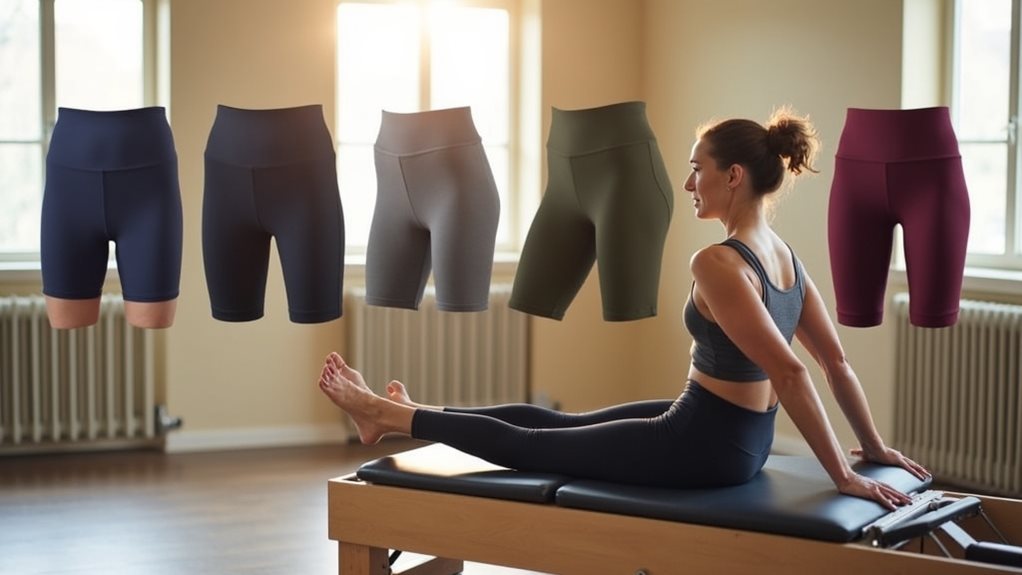
You’ll need just a sturdy chair without wheels, comfortable clothing, and a water bottle nearby. These exercises eliminate the barrier of getting up and down from the floor while still improving your flexibility and strength.
Here’s how to get started with chair-based mobility:
- Set up properly – feet flat on the floor, knees at right angles, and choose a chair without arms for better range of motion.
- Begin with basic movements – hamstring curls, gentle upper-body twists, and seated arm extensions.
- Progress gradually – start with 5 repetitions of each exercise, holding for 5-10 seconds, and aim to practice at least twice weekly.
Chair exercises are particularly beneficial for seniors as they improve balance and reduce the risk of falls while building confidence in movement.
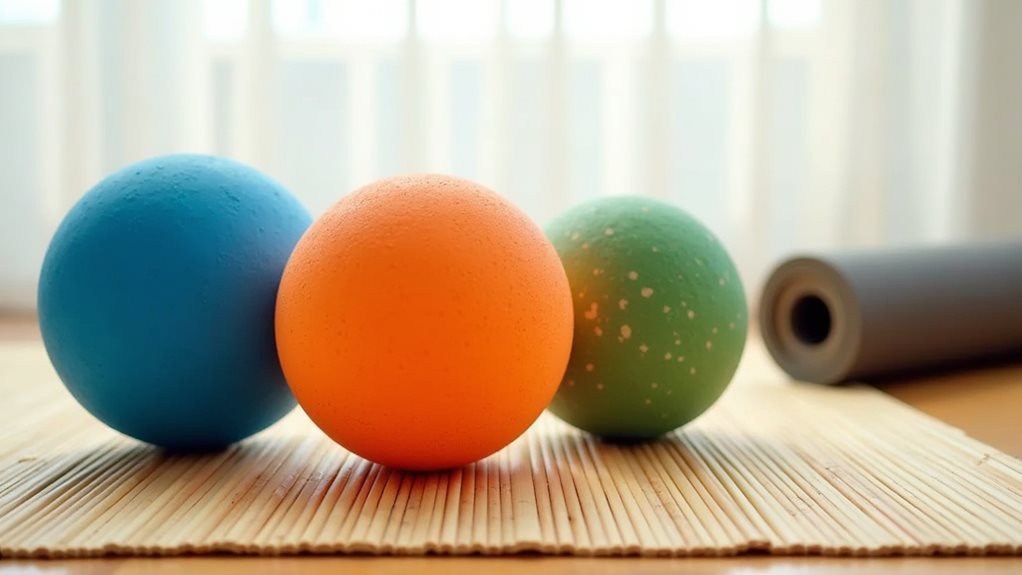
Consider using a small ball or rolled towel to provide resistance during exercises and enhance the engagement of your inner thigh muscles through squeezing movements.
Simple Core Activations
The comfort of chair-based exercises offers a great foundation, but incorporating simple core activations can truly transform your Pilates path when you’re feeling inflexible. Your core is your powerhouse, and it doesn’t require extreme flexibility to engage it properly.
Start with diaphragmatic breathing—inhale through your nose, filling your belly, then exhale through your mouth while gently drawing your navel toward your spine.
Try this lying down first, where it’s easiest to feel the connection. When you’re ready, explore modified movements like pelvic tilts or single-leg tabletop positions, keeping your lower back pressed into the mat.
Don’t worry if you can’t feel it immediately! Many beginners struggle to identify those deep abdominal muscles.
Remember: it’s not about crunching or sucking in—it’s about creating stability from within.
Essential Props and Tools That Support Limited Mobility
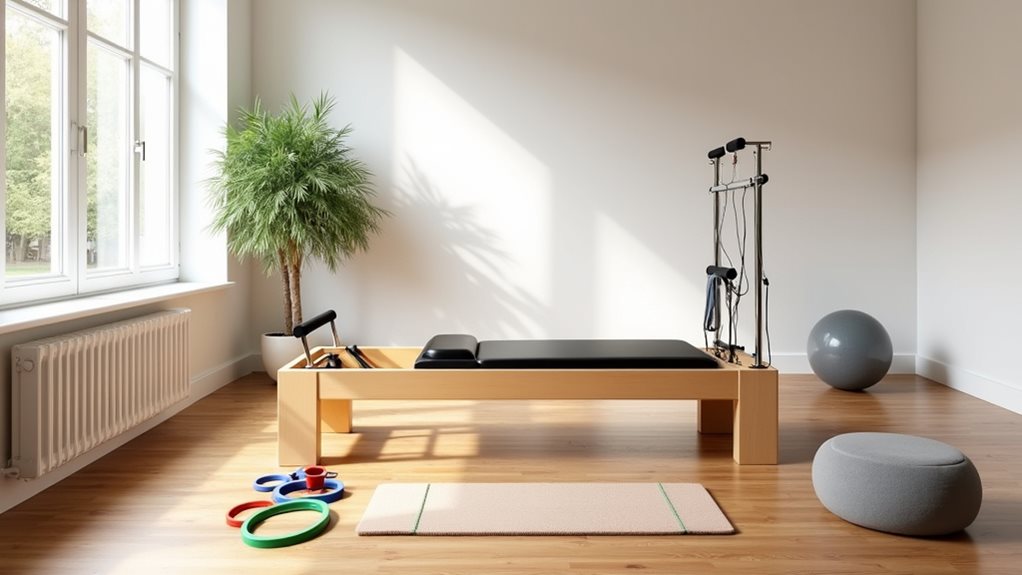
Although starting Pilates with limited flexibility might seem challenging, having the right props and tools can make all the difference in your expedition. You don’t need fancy equipment to begin your practice – simple, accessible tools can transform your experience.
- Resistance bands offer versatile support for both strengthening and flexibility work, with different resistance levels to match your needs as you progress.
- Stability balls and foam rollers challenge your balance while supporting spinal movement, making them perfect for improving core strength and body awareness.
- Alignment aids like blocks, headrests, and Pilates rings provide essential feedback and support, helping you maintain proper form even when flexibility is limited.
Building Confidence Through Progressive Flexibility Gains
Starting your Pilates expedition with limited flexibility might leave you feeling doubtful about your progress, but visible improvements will emerge sooner than you expect.
Research shows that practicing merely 2-3 times weekly leads to measurable gains within 8-12 weeks, with hamstrings, lower back, and shoulders showing the most dramatic changes.
Consistent Pilates practice rewires your body’s potential, transforming tight muscles into supple strength within just 2-3 months.
You’ll notice the difference not only in measurements, but in everyday life too. Suddenly, you’re bending with ease, reaching higher shelves, and moving more freely.
These functional improvements boost your confidence dramatically.
Track your progress every 4-6 weeks with simple tests like the sit-and-reach. You’ll be amazed at how far you’ve come!
How Pilates Addresses Common Causes of Stiffness
While most people attribute stiffness to a simple lack of stretching, Pilates addresses the deeper, multifaceted causes that keep your body rigid. Your stiffness likely stems from muscle imbalances, poor circulation, and postural misalignments—all issues Pilates tackles through controlled, flowing movements.
Here’s how Pilates uniquely addresses your stiffness:
- Simultaneous strengthening and lengthening – Unlike static stretches, Pilates keeps muscles warm and engaged while elongating them, creating lasting flexibility.
- Equal attention to both sides – Exercises like Single-Leg Stretch guarantee your body develops balanced flexibility, reducing strain and injury risk.
- Improved circulation to tight areas – Flowing movements deliver oxygen-rich blood to stiff joints and muscles, particularly in trouble spots like your lower back and shoulders.
You’re not “too stiff”—you’re exactly where you need to be to begin.
Frequently Asked Questions
How Long Until I Notice Flexibility Improvements With Pilates?
You’ll notice initial flexibility improvements within 3-4 weeks of consistent Pilates practice. Practice 2-4 times weekly for ideal results. More substantial gains emerge between 5-12 weeks, with full transformations appearing after 3-6 months.
Can I Do Pilates if I Have Joint Replacement Surgery?
Yes, you can do Pilates after joint replacement surgery. Start between 6-12 weeks post-op, beginning with gentle mat exercises under professional guidance. You’ll need to avoid hip flexion beyond 90 degrees and high-impact movements.
Should I Feel Pain During Pilates Stretches?
No, you shouldn’t feel pain during Pilates stretches. You’ll typically experience mild tension or a gentle pull, but sharp or stabbing pain signals you’re overstretching. Stop immediately if you feel actual pain.
Is Online Pilates Effective for Beginners With Stiffness?
Yes, online Pilates can be effective for you if you’re stiff and new to the practice. You’ll see improvements in flexibility and strength with consistent sessions, though you’ll miss some hands-on corrections from instructors.
How Does Pilates Compare to Yoga for Inflexible People?
Pilates offers more controlled, smaller movements that you’ll find easier with stiffness, while yoga involves deeper stretches. Both improve flexibility, but pilates focuses on strength-with-flexibility, and yoga on stretching through longer-held poses.
Final Thoughts
You don’t need to be flexible to start Pilates—you need Pilates to become flexible! Remember, everyone’s path begins somewhere, and your stiffness isn’t a barrier but your starting point. With modified exercises, helpful props, and consistent practice, you’ll soon notice your body responding with greater mobility. Trust the process, be patient with yourself, and celebrate each small improvement. Your more flexible future is just a few sessions away!